One of my favorite tools in SolidWorks is the Delete Face command. It probably has too many uses for me to list them all here but what I use them for mainly is surface reconstruction in SolidWorks native files and feature removal in imported files (files with NO feature tree).
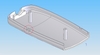
 In this tip, I wanted to show a little trick I learned recently while preparing some CAD data for FEA analysis. Sometimes, small features are removed for FEA analysis in order to simplify the meshing process. In this particular part to the left, the two circular cut features needed to be removed. This is a perfect
  application for the Delete Face command with the “Delete and Patch” option selected. After selecting only the faces that were part of the circular feature, the Delete Face command was invoked only to get a warning message that the faces could not be patched due to a “geometry condition”. Sometimes you run into this when the geometry of the features you would like to remove is too much for SolidWorks to handle.
 To simplify the faces being removed, a rectangular cut was added which removed
  the two circular features completely thus creating a larger, yet more simple cut. The Delete Face command was then applied to the three faces left by the rectangular cut and the feature was removed (and seamlessly patched) successfully!